Testour & Bulla Regia Private Day Trip
From $110, a private day trip to Testour and Bulla Regia. See a minaret clock that runs backward and Roman houses built under the ground.



This private day trip follows the Medjerda valley into the northwest of Tunisia. In Testour, you see the Great Mosque, built by Andalusian refugees, and its clock that turns the wrong way. In Bulla Regia, you go down into Roman houses built partly under the ground, with their mosaics still in place. Your driver picks you up at your hotel, at a fixed price per vehicle.
The valley holds two very different stories. One is about refugees from Spain in the 17th century, the other about a royal city of the Numidians.
Andalusian Muslims driven out of Spain settled in Testour in the early 17th century. Mohamed Tagharinou, who arrived around 1609, is credited with building the Great Mosque. Its minaret, square at the base and eight-sided above, looks more like a church tower from Aragon. Its bricks and glazed tiles recall the towns its builders had left behind.
High on the minaret, a clock turns backward, with its numbers facing inward. Tradition links it to the longing of the Andalusians, as if they wished time could take them home. The clock stood still for nearly three centuries, until the engineer Abdel Halim Koundi made it run again. The minaret also bears six-pointed stars, a motif common on Tunisian mosques and doors.
Testour stands on the site of Tichilla, a Roman town at the mouth of the Siliana valley. It looks over the Medjerda valley, among wheat fields and olive groves. The Andalusians rebuilt the town on their own plan, with a main street and a square. Its houses still follow that layout today.
The Andalusians also brought their music, the malouf, played in long suites called nubas. The word malouf means customary, music handed down from one generation to the next. Testour has kept it alive. Since 1967, the town has hosted an international festival of malouf and traditional Maghrebi music. During the festival, orchestras and singers from across the region fill its square.
Bulla Regia means royal Bulla. In 156 BC, the Numidian king Masinissa made it one of his royal seats. In 46 BC, Julius Caesar made it a free city, and under Hadrian it became a Roman colony. Its people then received full Roman citizenship. Saint Augustine later scolded its citizens in a sermon for their love of shows.
To keep cool in summer, wealthy families built their houses partly under the ground. The main rooms lay below a courtyard, cool and lit from above. Water sprinkled on the floors kept them cooler still. Many of these lower floors have survived, with their mosaics in place. They are the reason the site is famous.
The House of Amphitrite takes its name from the mosaic of its underground room. It shows the sea goddess Amphitrite, her head circled by a halo, among creatures of the sea. The finest mosaics of Bulla Regia are said to be unsurpassed in North Africa. Many were left where they were laid.
Excavations began at Bulla Regia in 1906, and the forum was cleared between 1949 and 1952. The House of the Hunt has a hall laid out like a small basilica, a plan that churches later took up. The owner of the House of the Fisherman closed a street to join two blocks. The site is quiet, so take your time.
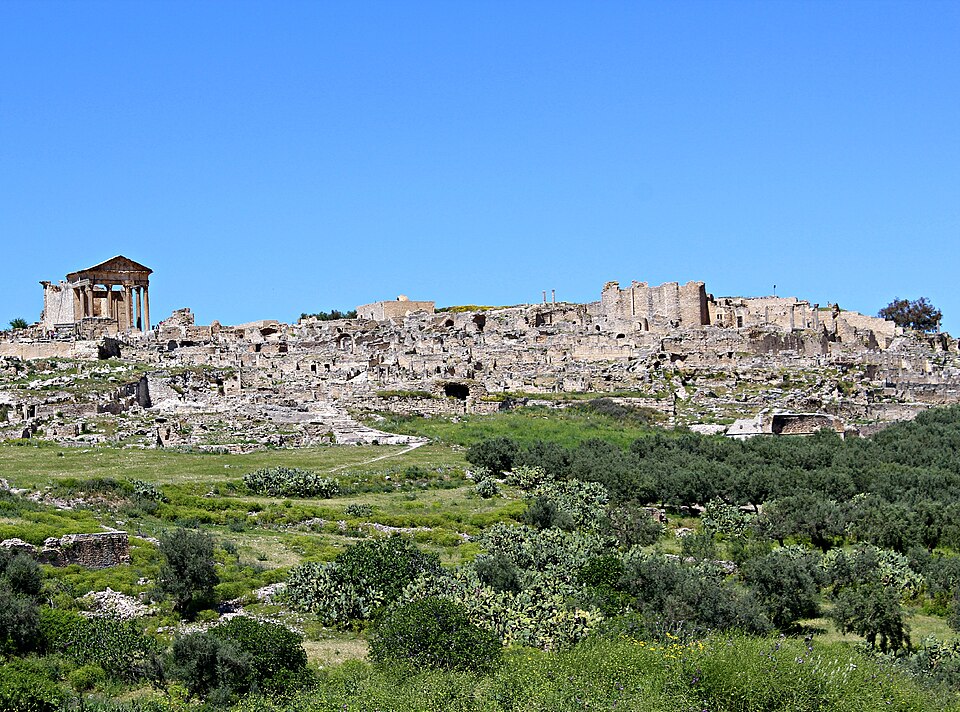
We drive west through wheat fields and olive groves, with Testour first and Bulla Regia after lunch. Ask us if you want to add Dougga, which lies close to the road.
Tunis is the closest departure city, with a price of $110 for the whole vehicle. From the coast, the drive is longer and the price follows. Each price covers the driver, fuel and tolls, and nothing is added on the day. With a certified guide, add $50 for the day.
Price per private vehicle, in US dollars
| Departure city | Price |
|---|---|
| Departure from Tunis or Gammarth | $110 |
| Departure from Hammamet | $135 |
| Departure from Nabeul | $145 |
| Departure from Sousse | $155 |
| Departure city | Price |
|---|---|
| Departure from Monastir | $165 |
| Departure from Mahdia | $180 |
| Departure from Bizerte | $130 |
| Departure from Djerba | $260 |
Your price pays for the car and the driver from morning to evening. The ticket for Bulla Regia and your lunch are paid on the spot.
The road up the Medjerda valley and back is fully covered, with the car and the driver.
Only Bulla Regia sells a ticket, and Testour is free to walk.
Send us your hotel name, the date and how many people are coming. Our team confirms the trip and the price in writing. Reach us any time on WhatsApp.
Yes. Its hands turn the opposite way from a normal clock. It was restored in the 2010s and still works.
Yes. Stairs lead down into the cool rooms, where the mosaics are still on the floors.
Dougga is close to Testour, so it can be added. Ask our team when you book, and they confirm the plan.
A moderate amount. Bulla Regia is a large site with uneven ground, so wear comfortable shoes.
Yes. Only your group travels in the vehicle, and the driver adapts to your pace.
Dougga and Zaghouan show more of Roman Africa, a little further east. To the north, Tabarka and Aïn Draham bring you to the coast and the forests.

Reviews left on Google by travelers who booked with us.
"Abbiamo organizzato un road trip in Tunisia con questa agenzia e ci siamo trovati molto bene. Persone oneste e tutto è filato liscio. Il driver Salah è il migliore."
"Mr Faizal was a great private driver and guide. We went with him to two berber villages (Takrouna and Zriba olia). He gave us insights about the places we were visiting. And the next day we also went to the airport with him. His car is new, clean and comfortable."
"Un grand merci, équipe ponctuelle, sérieuse et très aimable aussi bien pour le transfert aéroport tunis hôtel, que pour l'excursion que nous avons programmé avec eux. Un grand merci à slah qui fut notre chauffeur pour ces deux services!"