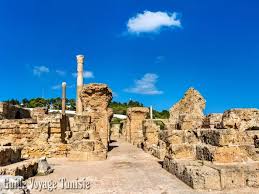
Dougga & Zaghouan Private Day Trip
From $100, a private day trip to Dougga, the best preserved Roman town in North Africa. You also see the Water Temple of Zaghouan, with pickup at your hotel.


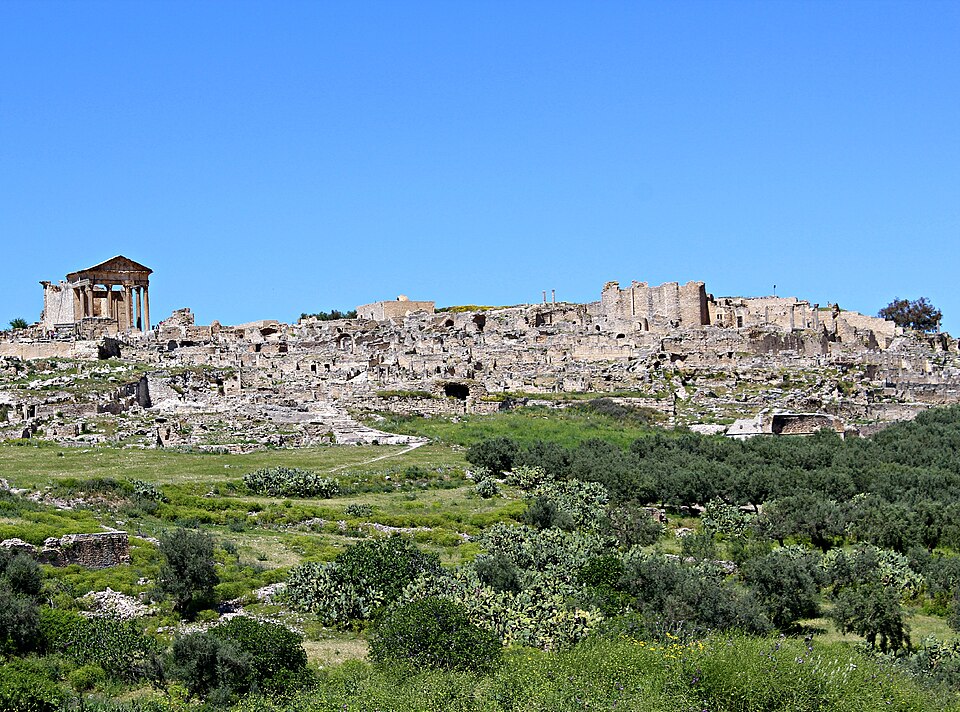
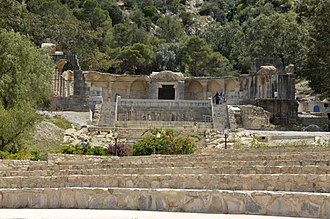
This private day trip takes you inland, to the hills and olive groves of northern Tunisia. In Dougga, you walk through a Roman town with its Capitol, theater and houses. In Zaghouan, you see the Water Temple built where the aqueduct of Carthage began. Your driver picks you up at your hotel and drives you back in the evening, at a fixed price per vehicle.
Rome left many towns in Tunisia, but few kept their streets and temples like Dougga. Zaghouan, for its part, gave Carthage its water for centuries.
Long before Rome, Dougga was Thugga, a Numidian town that already existed in the 6th century BC. Its Libyco-Punic Mausoleum, built in the 2nd century BC, still stands at the edge of the site. Its bilingual inscription, now in the British Museum, helped scholars decode the Libyan script. A temple to King Masinissa, dated 139 BC, lies under the forum.
Under Rome, Thugga grew into a busy town on its hilltop, among wheat fields and olive groves. The Capitol, dedicated to Jupiter, Juno and Minerva, was finished in 166 or 167. After independence, the last villagers living among the ruins moved to New Dougga, on the plain below. UNESCO listed the site in 1997 as the best preserved Roman small town in North Africa.
The theater of Dougga was built in 168 or 169 and seated 3,500 people, in a town of some 5,000. It is one of the best preserved in Roman Africa. The Temple of Saturn dates from the reign of Septimius Severus. The Temple of Juno Caelestis, built between 222 and 235, honored the Roman form of the Punic goddess Tanit.
Paved streets still link the forum, the market and the Licinian Baths, given to the town in the 3rd century. Two arches still stand, one built in 205 for Septimius Severus and one for Severus Alexander. Mosaics found on the site, such as the Cyclops mosaic, are now at the Bardo Museum. Wear good shoes, as the stone paths climb steeply.
Zaghouan stands on the site of Ziqua, a Roman town of which only a gate survives. Above it rises Jebel Zaghouan, the mountain whose springs gave Carthage its water. The old town has steep streets and small squares that open onto views of the plain. It is a quiet place, away from the tourist roads.
In the 17th century, Andalusian Muslims expelled from Spain settled in Zaghouan and planted roses. Their flowers still give nesri, the rose water used in local pastries. The most famous is kaak warka, a ring of pastry made with nesri, which even has its own festival in town. Ask your driver for a stop at a pastry shop.
The Romans built this temple over the spring of Zaghouan in the first half of the 2nd century. A crescent of columns and niches wraps around a basin, with a small shrine at the back. Most of its statues are now at the Bardo Museum. The work is often linked to Emperor Hadrian, whose visit in 128 ended a long drought.
From the temple, one of the longest aqueducts of the Roman Empire carried the water to Carthage. It filled the cisterns that supplied the Antonine Baths, opened in 162. After centuries of damage, the aqueduct was restored in 1859 by the French engineer Pierre Collin. It still brings water to Tunis today, and its arches can be seen along the road.
Dougga is the long drive of the day, so we leave early and stop at Zaghouan on the way back. The road crosses wheat fields and olive groves.
Tunis is the closest departure city for this trip, so the price starts there at $100. From the coast, the price rises with the distance. Whatever the city, the price covers the vehicle, the driver, fuel and tolls. A certified guide adds $50 for the day, a good idea at Dougga.
Price per private vehicle, in US dollars
| Departure city | Price |
|---|---|
| Departure from Tunis or Gammarth | $100 |
| Departure from Hammamet | $125 |
| Departure from Nabeul | $135 |
| Departure from Sousse | $145 |
| Departure city | Price |
|---|---|
| Departure from Monastir | $155 |
| Departure from Mahdia | $170 |
| Departure from Bizerte | $125 |
| Departure from Djerba | $250 |
The vehicle, the driver and the long road inland are all in the price. Site tickets are paid at the entrance.
One fixed price pays for the car, the driver and the whole road, from your hotel and back.
Your own spending during the day stays outside the price, and the guide is up to you.
Send us your hotel, the date and the size of your group. Our team confirms the trip with the fixed price. You can write to us on WhatsApp at any hour.
The site covers a whole hillside, with uneven stone paths. Wear good shoes, and plan two hours or more for the main monuments.
Yes. Dougga has many monuments, and a guide helps you read them. A certified guide costs $50 for the whole day.
Spring and autumn are the most pleasant. In summer, start early, as there is little shade on the hill.
Yes. Both cities are in the price table, and the driver picks you up at your hotel there.
Yes. You travel with your own driver, and no one else joins your vehicle.
The northwest has more Roman and Andalusian towns, such as Testour and Bulla Regia. Closer to the capital, the classic tour of Tunis, Carthage and Sidi Bou Saïd fills another day.

Reviews left on Google by travelers who booked with us.
"Mr Faizal was a great private driver and guide. We went with him to two berber villages (Takrouna and Zriba olia). He gave us insights about the places we were visiting. And the next day we also went to the airport with him. His car is new, clean and comfortable."
"Abbiamo organizzato un road trip in Tunisia con questa agenzia e ci siamo trovati molto bene. Persone oneste e tutto è filato liscio. Il driver Salah è il migliore."
"We are a family of 4 (kids 10 and 8), who traveled to Tunisia back at the end of October. We had the pleasure of using Tunisie Transferts and Tours for all of our long distance travel needs. We traveled from Tunis to Kairouan to Tozeur to Hammamet to Tunis. The service they provide is top notch and affordable!"